On May 28 the Pennington Borough Environmental Commission hosted an online discussion about energy, practical solutions, and the development of the town’s Community Energy Plan. A recording the the online session is on the HVGT YouTube channel here.
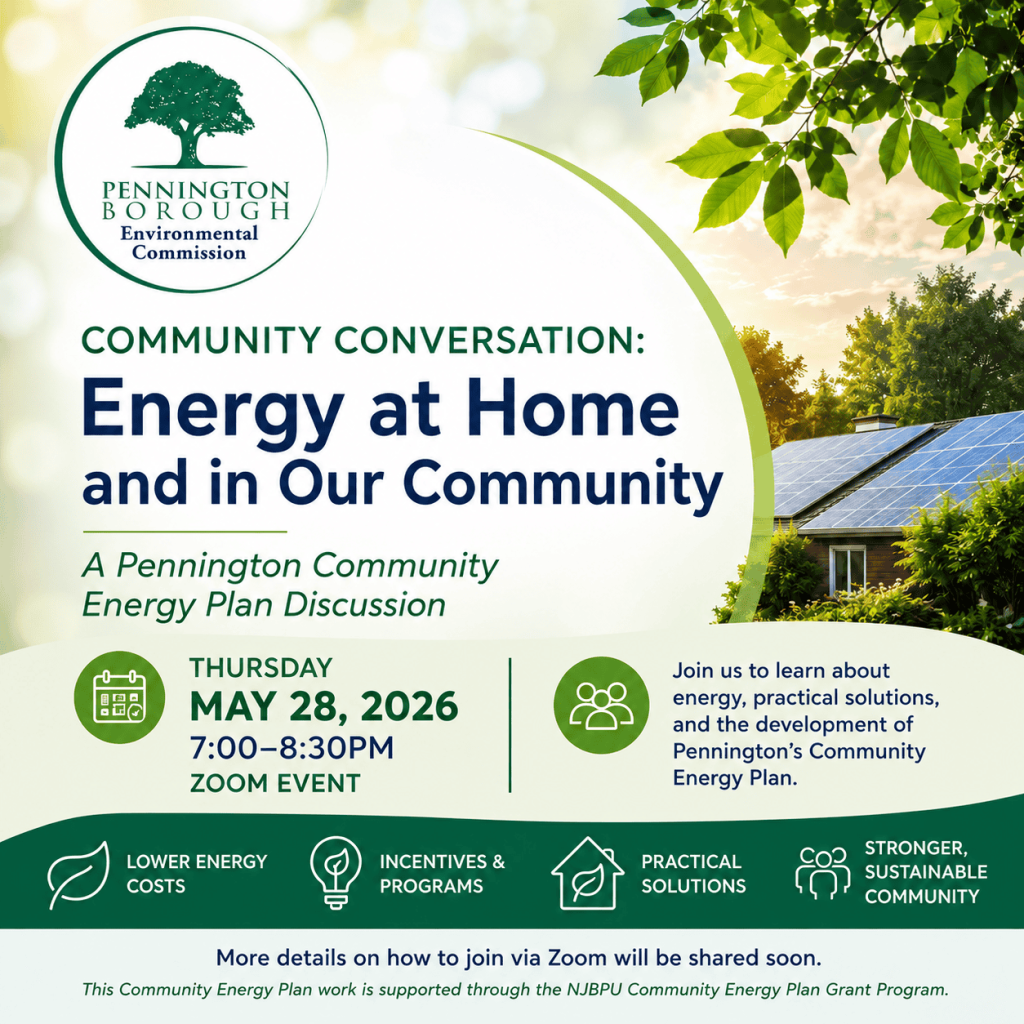

On May 28 the Pennington Borough Environmental Commission hosted an online discussion about energy, practical solutions, and the development of the town’s Community Energy Plan. A recording the the online session is on the HVGT YouTube channel here.
Our first upcycling/recycling collection of 2026 will be Sunday, May 10 from 9:00 am to 1:00 pm at the Hopewell Borough Farmers Market at 52 East Broad Street (in the grassy area between PNC Bank and Hopewell Village Square shopping plaza). We collect specific items and materials for reuse, recycling and diversion for proper disposal.
The Pennington Farmers Market collection dates are the last Saturday of the month: June 27, July 25, August 29, September 26, and October 31, 2026. Future Hopewell Borough dates: June 14, August 9, September 13, October 11, and November 8.
Click here for more information.
In 2025 Hopewell Borough residents are to vote on a referendum question asking if the town’s public water system should be sold to a private corporation. Below are sources for information and considerations both pro and con. Please contact us if you would like to suggest additional web-accessible sources.
MercerMe published articles describing the numerous public meetings about the water system sale:
Hopewell Express has also published a couple of articles about the proposed sale:
CentralJersey.com has published a few as well:
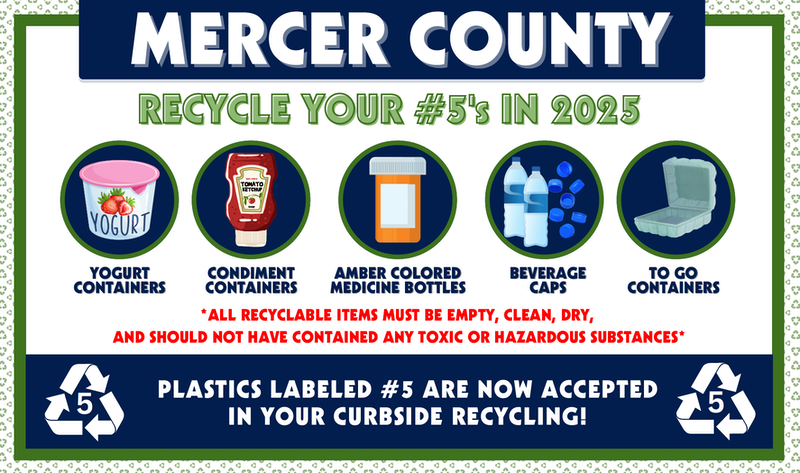
Starting December 2024 residents in Hopewell Valley (and other Mercer County municipalities served by MCIA’s hauler) can put plastic containers labeled ♷ (#5) in curbside buckets for recycling. These include:
The containers should be empty and rinsed out so there isn’t any food or liquid residue, and must not have been used to hold toxic or hazardous substances. Remove caps from bottles, too.
The U.S. Environmental Protection Agency acknowledges that recycling symbols on plastic consumables are confusing. As CBS News reported on July 31, 2023, the agency advocates changing some of them. The official comment cited in this report, issued by the EPA to the Federal Trade Commission, reads in part:
EPA recommends that the FTC address confusion created by the chasing arrows symbol and the resin identification codes by revising the Green Guides to reflect the intention of the ASTM standard for resin identification coding. EPA believes the use of the RIC with the chasing arrows symbol constitutes a misrepresentation and violation of claims prohibited under Section 5 of the FTC Act – “A representation, omission, or practice is deceptive if it is likely to mislead consumers acting reasonably under the circumstances and is material to consumers’ decisions.” Consumers generally understand the chasing arrows triangle to represent a universal recycling symbol and interpret it to mean that the product is recyclable, and its use with the resin identification codes influences consumer decisions on how they dispose of plastic products.
According to ASTM standard D7611/D7611M, the intention of the coding system was never to determine the recyclability of a product, but to determine resin composition and quality control measures before recycling. Not all resin codes can be recycled currently in the United States. Resin codes 3-7 cannot be recycled in most material recovery facilities and do not have strong end markets. The issue is not the resin codes themselves, but the implication that all of them can be recycled. This implication is made when the numbers are combined with the chasing arrows symbol, which is why the combination becomes deceptive or misleading. As such, the current ASTM standard no longer uses the chasing arrows symbol to surround the number and has switched to an equilateral triangle. Moreover, California passed SB 343, which prohibits the use of the chasing arrows or any other indicator of recyclability on products and packaging unless certain criteria are met.
EPA believes updates to the FTC Green Guides “recyclable” claims can be a tool to reduce consumer confusion that contributes to recycling facilities receiving many plastic materials that they do not accept and cannot recycle, which adds a financial burden to facilities and taxpayers to haul, process and ultimately incinerate or landfill this contamination.
Download and read the entire comment by EPA on Green Guides Review, Matter No. P954501, here: https://www.regulations.gov/comment/FTC-2022-0077-1366
Residents of Hopewell Valley are able to subscribe to regular curbside pick-up of their food waste by two local services:
Both services provide finished compost to subscribers for use in gardens/yard. Some of the great benefits of diverting food waste from the landfill into compost are described here as well as on each of the services’ websites.
For HV Green Week in April 2022 the Hopewell Valley Green Team hosted a virtual forum, “Decarbonize Your Home.” The HVGT and local experts outlined a variety of options and provided many resources which are now summarized here (energy efficiency), here (electrification) and here (renewable energy).
A video recording of the webinar can be viewed on YouTube here.
In January, 2022, NJ Governor Phil Murphy signed into law legislation requiring an increase in the content of post-consumer recycled plastics, glass and paper in various packaging products (S2515/A4676).
Beginning in 2024…
Note that packages or containers for milk products, plant-based “milk” products, medical food, and infant formula are exempt from the above requirements for recycled content.
Summaries and commentary about the new law were published on the websites WasteDive, Resource Recycling, and Beyond Plastics (and elsewhere).